
ASA physical status in a logbook
Most logbooks record an ASA grade for every case. This is what the classes are, who assigns them, and what to write down.
3 minute read · Reviewed 28 November 2026
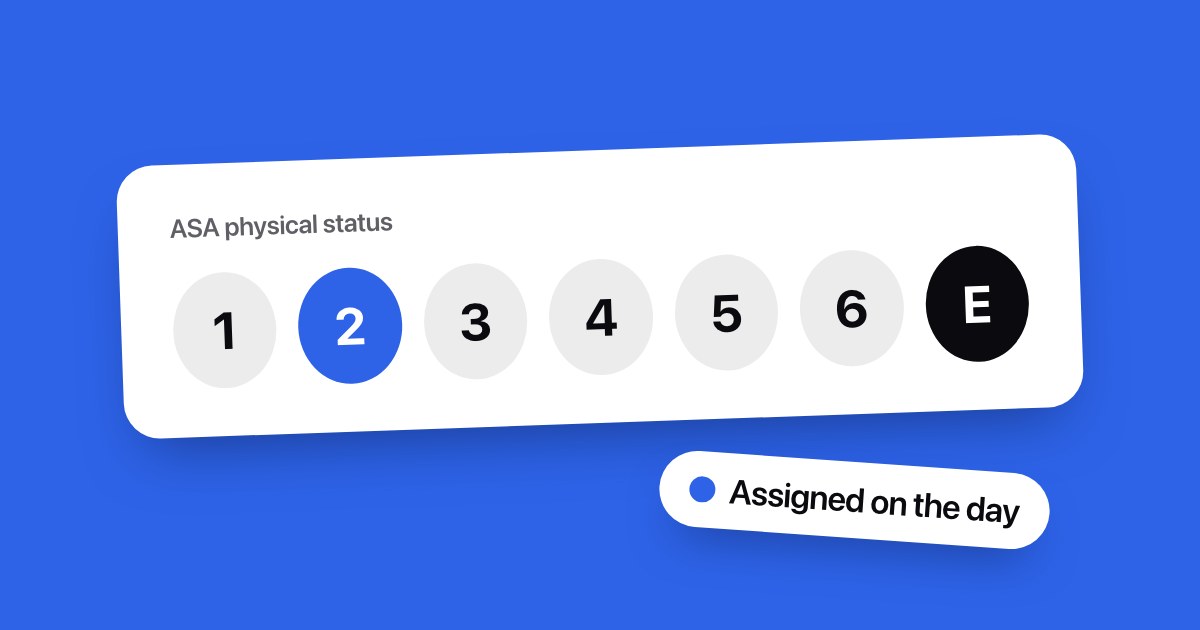
What the scale is for
The American Society of Anesthesiologists says its Physical Status Classification System has been in continuous use since 1961, and that its purpose is to assess and communicate a patient's medical conditions before anaesthesia. Used with other factors, such as the type of surgery, it helps to estimate perioperative risk [1].
The six classes
These are the ASA's definitions in brief. The full statement, with the ASA's approved examples for adults, children and obstetric patients, is at the source [1].
| Class | Definition |
|---|---|
| ASA I | A normal healthy patient. |
| ASA II | A patient with mild systemic disease. |
| ASA III | A patient with severe systemic disease. |
| ASA IV | A patient with severe systemic disease that is a constant threat to life. |
| ASA V | A moribund patient who is not expected to survive without the operation. |
| ASA VI | A patient declared brain-dead whose organs are being removed for donation. |
Adding E marks emergency surgery. The ASA defines an emergency as existing when a delay in treating the patient would significantly increase the threat to life or to a body part [1].
The statement also explains why an uncomplicated pregnancy is given ASA II: pregnancy is not a disease, but the body's state is significantly altered by it [1].
Who decides the class
The ASA describes assigning a class as a clinical decision based on many factors. The class may be estimated at several points before surgery, but the final one is assigned on the day of anaesthesia care by the anaesthetist, after evaluating the patient [1].
The ASA calls its definitions and examples guidelines for the clinician, and says a department may add examples of its own [1]. This page does not reproduce the examples and cannot tell you which class a patient belongs in.
In a logbook
- Record the class that was assigned for the case, with E if it was an emergency. Do not score it again from memory later.
- Record the class and nothing about the conditions behind it. The diagnosis belongs in the patient's record, not in your logbook.
- Counted over a year, the classes show how sick the patients you cared for were, which is part of your case mix.
Induct records ASA as 1 to 6 with E, and its reports count cases by class.
Sources
- American Society of Anesthesiologists. Statement on ASA Physical Status Classification System. Anesthesiology Open 1(1): e0002, April 2026.
All read on 28 November 2026.