
The NCEPOD classification of intervention in a logbook
Immediate, urgent, expedited or elective. This is what NCEPOD means by each, who assigns it and what to write down.
3 minute read · Reviewed 28 November 2026
What it is
The National Confidential Enquiry into Patient Outcome and Death (NCEPOD) publishes a classification of how urgent an intervention is. It came into effect in December 2004 and replaced the words NCEPOD used before: emergency, urgent, scheduled and elective. NCEPOD says it was drawn up with the help of the surgical specialist societies, the British Cardiac Society and the Royal College of Radiologists [1].
The four categories
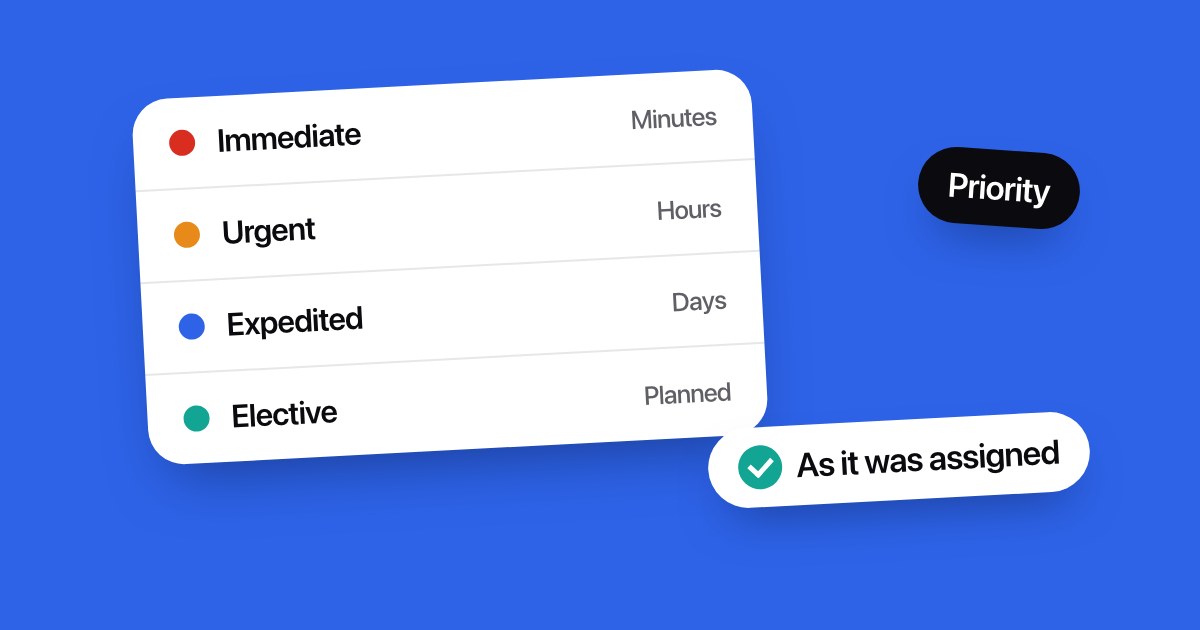
In summary, with NCEPOD's own wording and its examples at the source [1]:
| Category | In summary | Normally |
|---|---|---|
| Immediate | To save life, a limb or an organ, with resuscitation going on at the same time as the intervention. | Within minutes of the decision to operate |
| Urgent | For a condition of sudden onset or worsening that threatens life or an organ, for fixing fractures, and to relieve distressing symptoms. | Within hours of the decision to operate |
| Expedited | Early treatment for a stable patient whose condition is not an immediate threat to life, a limb or an organ. | Within days of the decision to operate |
| Elective | Planned or booked ahead of a routine admission. It takes in everything that is not immediate, urgent or expedited. | At a time that suits the patient, the hospital and the staff |
NCEPOD's summary table says it excludes obstetrics [1].
The category belongs to the patient, not the operation
The same operation can fall in any category. NCEPOD's own example is a hemicolectomy, which it places as immediate for life-threatening bleeding, urgent for a perforated bowel, expedited for a developing obstruction and elective for a cancer that is not obstructing [1].
Nor is the category the kind of list the case was done on. NCEPOD calls the patient's urgency and the type of list independent variables that must be kept distinct, and says the classification does not describe the theatre session [1]. An expedited case done on an emergency list is still expedited.
Who assigns it
NCEPOD recommends that the consultant who will perform the intervention assigns the category, at the time of the decision to operate and when the theatre is booked. It should be recorded in the theatre management system and in the patient's casenotes [1].
In a logbook
- Copy the category the case was given. Do not grade it again yourself afterwards.
- If the theatre record uses other words, such as emergency or scheduled, ask what your department means by them before you translate.
- Record the category and nothing about the diagnosis behind it.
The Royal College of Anaesthetists' curriculum says a logbook review should consider the balance of elective and emergency cases, with the mix of cases and the level of supervision [2]. A category on every case is what lets a logbook show that balance.
In Induct
The Priority field of a case offers the four categories by name: Immediate, Urgent, Expedited and Elective. Reports can count your cases by priority.
Sources
- National Confidential Enquiry into Patient Outcome and Death. The NCEPOD Classification of Intervention.
- Royal College of Anaesthetists. 2021 Curriculum for a CCT in Anaesthetics: Evidence of progress.
All read on 28 November 2026.