
Keeping patient details out of a logbook
A logbook is about you, not your patients. This is what counts as identifying in the UK and in the US, and how to keep it out.
6 minute read · Reviewed 28 November 2026
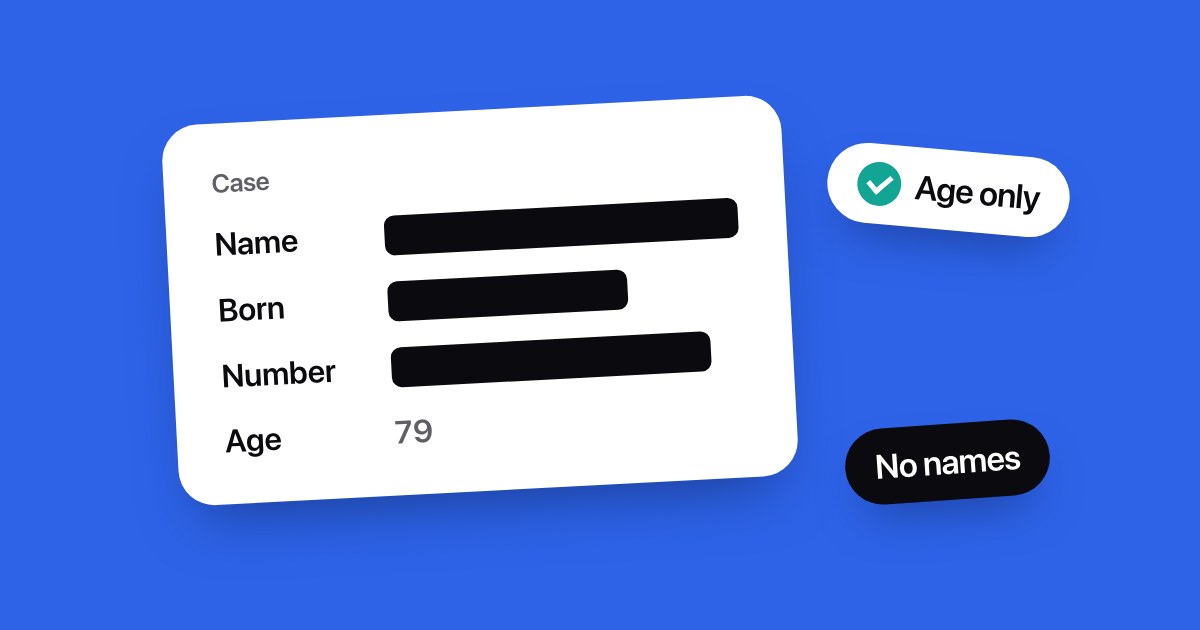
Removing the name is not enough
The UK's General Medical Council says training records must be anonymised as far as possible, and is clear about how high the bar is: taking out the name, the age, the address and other personal identifiers is unlikely to be enough by itself (paragraph 14) [1].
The standard it refers to is the one used by the Information Commissioner's Office: information is anonymised if it does not itself identify anyone and is unlikely to allow anyone to be identified when combined with other data [1].
Where that standard is hard to reach, the same guidance says to ask for the patient's consent if you can. If that is not practicable, it allows potentially identifiable information in a training record as long as the record is kept securely and handled in line with data protection requirements, and it still expects as many identifiers as possible to be removed (paragraph 15) [1].
What the US rule lists
In the United States, the HIPAA Privacy Rule sets out a "Safe Harbor" method under which health information counts as de-identified once 18 kinds of identifier are removed, provided the holder has no actual knowledge that what remains could identify the person [2]. The identifiers a logbook is most likely to touch are:
- names;
- geographic subdivisions smaller than a state;
- all elements of dates, except the year, that relate directly to a person, including birth, admission and discharge dates;
- all ages over 89, which may only be grouped as "90 or older";
- medical record numbers;
- full-face photographs and comparable images;
- any other unique identifying number, characteristic or code.
Three points from the official guidance are easy to miss:
- Initials do not help. Asked whether parts of an identifier may be kept, the guidance answers no: "a data set that contained patient initials, or the last four digits of a Social Security number, would not meet the requirement of the Safe Harbor method" [2].
- The exact date is on the list. "Elements of dates that are not permitted for disclosure include the day, month, and any other information that is more specific than the year of an event" [2]. A logbook that records the day of each case is therefore not de-identified by this method, however little else it holds. Treat it as confidential, and ask your hospital or program what its policy allows on a personal device.
- A reference must not be built from the patient. A code may be kept only if it "is not derived from or related to information about the individual" [2]. A case number you make up is fine. One built from initials, a birth date or record number digits is not.
Rules that work in both countries
- Record the age, never the date of birth. The Royal College of Anaesthetists recommends recording only the age, the sex and the ASA grade of a patient, and keeping no other unique numbers [3].
- If you keep a case reference, number your cases yourself: 1, 2, 3.
- Write notes and significant events without names, including the names of colleagues.
- Be careful with rare cases. A very unusual operation or condition, with the exact date and the hospital, can point to one person.
- Do not photograph a face, a wristband, a chart or a screen that shows a label.
- Lock the device the logbook is on.
- Know where your backups go. The Royal College of Anaesthetists asks trainees to be mindful of logbooks that are backed up in the cloud [3].
- Clean an old logbook before you move it. Delete columns that hold names, numbers or dates of birth first.
What Induct does, and what it leaves to you
- A case has no field for a name, an address, a date of birth or a hospital number.
- If you enter a date of birth to work out an age, the app keeps the age and not the date.
- Photos you attach are resized and their metadata, including location, is removed.
- There is no Induct account or server. Cases stay on your devices, and in your own iCloud if you turn sync on.
Induct does record the date of each case, because a logbook is counted by period. It cannot check what you type into notes, a case reference or a photo. Those are yours to keep clean.
Sources
- General Medical Council. Confidentiality: disclosing information for education and training purposes, paragraphs 14 and 15.
- US Department of Health and Human Services. Guidance regarding methods for de-identification of protected health information, on 45 CFR 164.514(b) and (c).
- Royal College of Anaesthetists. 8. Training documentation, sections 8.2 and 8.2.1. An older document: it cites the Data Protection Act 1998.
All read on 28 November 2026.