
ACGME case log requirements for anesthesiology residents
The patient numbers a US anesthesiology residency has to provide, and the rules for counting a case, as the ACGME's own documents state them.
4 minute read · Reviewed 28 November 2026
Where the rules are written
The ACGME describes its Case Log System as a web application in which residents and fellows are required to log their clinical experiences. Residents are expected to meet or exceed the minimums for their specialty by graduation, as verified by the program director [1].
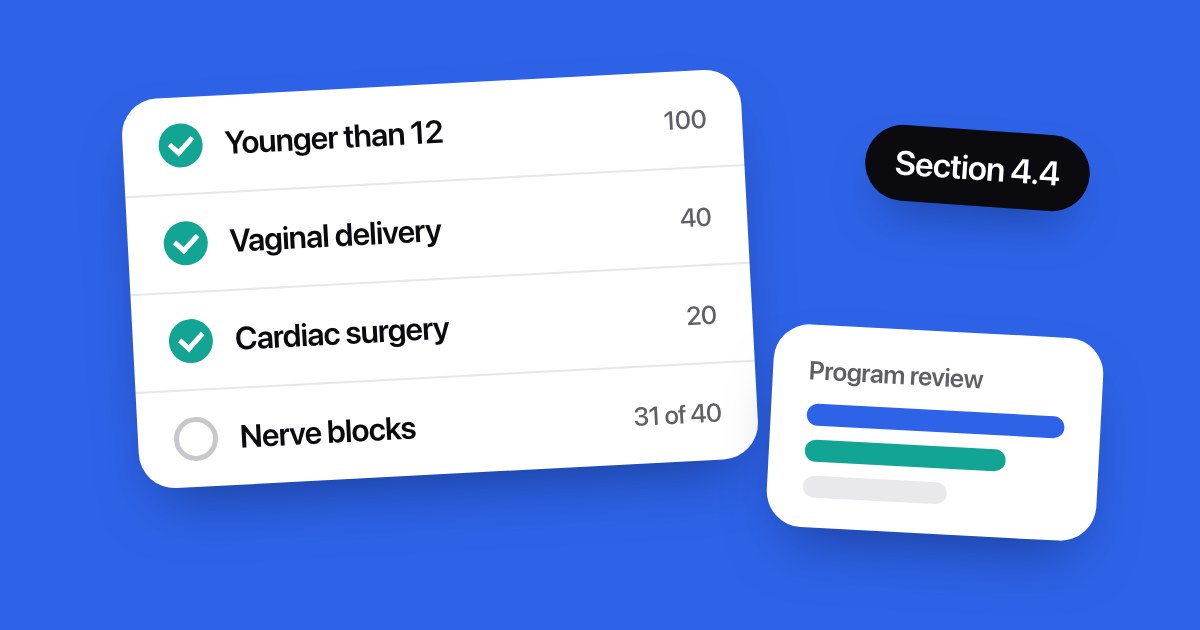
For the anesthesiology residency, the numbers are in the ACGME Program Requirements for Graduate Medical Education in Anesthesiology, in section 4.4. This page follows the version in effect since July 1, 2026 [2]. The version that takes effect on July 1, 2027 is already published and carries the same numbers [3].
Fellowships have documents of their own. The ACGME's anesthesiology page lists case log documents for pediatric anesthesiology, pediatric cardiac anesthesiology, regional anesthesiology and acute pain medicine, and adult cardiothoracic anesthesiology [4].
The numbers
The requirements word each of these as experience that must involve care for a number of patients. They are summarized here, and the wording that counts is the ACGME's [2].
| Experience | Patients |
|---|---|
| Patients younger than 12 years | 100, with 20 younger than three years, five of those younger than three months |
| Patients presenting for initial evaluation of pain | 20 |
| Vaginal delivery | 40 |
| Cesarean section | 20 |
| Cardiac surgery | 20, with 10 involving cardiopulmonary bypass |
| Open or endovascular procedures on major vessels | 20, not counting surgery for vascular access |
| Non-cardiac intrathoracic surgery | 20 |
| Intracerebral procedures, including endovascular ones | 20, the majority with an open cranium |
| Epidural anesthetic, or an epidural catheter placed for perioperative analgesia | 40 |
| Procedures for complex, immediately life-threatening pathology | 20 |
| Spinal anesthetic for a surgical procedure, including cesarean section | 40 |
| Peripheral nerve block as part of the anesthetic or of perioperative analgesia | 40 |
The same section names experience with no number attached, such as patients with acute postoperative pain, a broad range of airway techniques, and procedures outside the surgical suite [2].
How a case is counted
The frequently asked questions at the end of the same document answer the common counting questions [2].
- Two techniques in one procedure. Both may be counted. A patient who has an epidural and a general anesthetic can count as a general anesthesia case and as an epidural.
- What kind of epidural. One used during surgery is an epidural anesthetic. One placed only for pain control after the operation is an epidural for pain management.
- Regional with sedation. A regional anesthetic given with sedation and monitored anesthesia care can count as both.
- Two residents on one case. Both can take credit if both were involved in the majority of a major case, including its most significant portions. When one resident finishes a case for another, only the one involved in the most significant aspects, or in the majority of the procedure, should record it.
- The fundamental clinical skills year. Anesthesia experience gained in it can and should be logged, entered as year 1 in the program.
- Transfers. Experience from another ACGME-accredited anesthesiology program should be included in your Case Logs. The program director or coordinator requests the transfer in the system. This does not apply to residents who come from another specialty.
What your program does with the log
- The program director must ensure regular review of residents' clinical experience logs, and verify that they are accurate and complete when they are sent to the Review Committee (4.11.n) [2].
- The logs are submitted to the Review Committee every year, in the format and by the date it sets (4.11.n.1) [2].
- At the end of the program, the Milestones and, when applicable, the Case Logs must be used as tools in the final evaluation (5.2.a) [2].
- Review Committees also use program-level Case Log data to judge whether a program has enough patients and cases for the number of residents it trains [1].
What this page cannot tell you
- How and when your program wants cases entered. Your program director and coordinator decide that.
- Whether the requirements have changed since the review date above. The ACGME revises them, so read the current document before you rely on a number [2].
- This page is not written or endorsed by the ACGME.
A personal log beside it
The Case Log System is the record that counts. Many residents also keep a log of their own, which stays with them after graduation. A personal case log alongside the one your program requires explains how the two fit together.
Induct is a personal log of that kind. It sends nothing to the ACGME or to your program, and its totals do not stand in for the official ones.
Sources
- Accreditation Council for Graduate Medical Education. ACGME Answers: a look at Case Log minimums, 26 September 2024.
- Accreditation Council for Graduate Medical Education. ACGME Program Requirements for Graduate Medical Education in Anesthesiology, including FAQs, effective July 1, 2026 (PDF).
- Accreditation Council for Graduate Medical Education. ACGME Program Requirements for Graduate Medical Education in Anesthesiology, including FAQs, effective July 1, 2027 (PDF).
- Accreditation Council for Graduate Medical Education. Anesthesiology: documents and resources.
All read on 28 November 2026.