
What to record for every case, and what to leave out
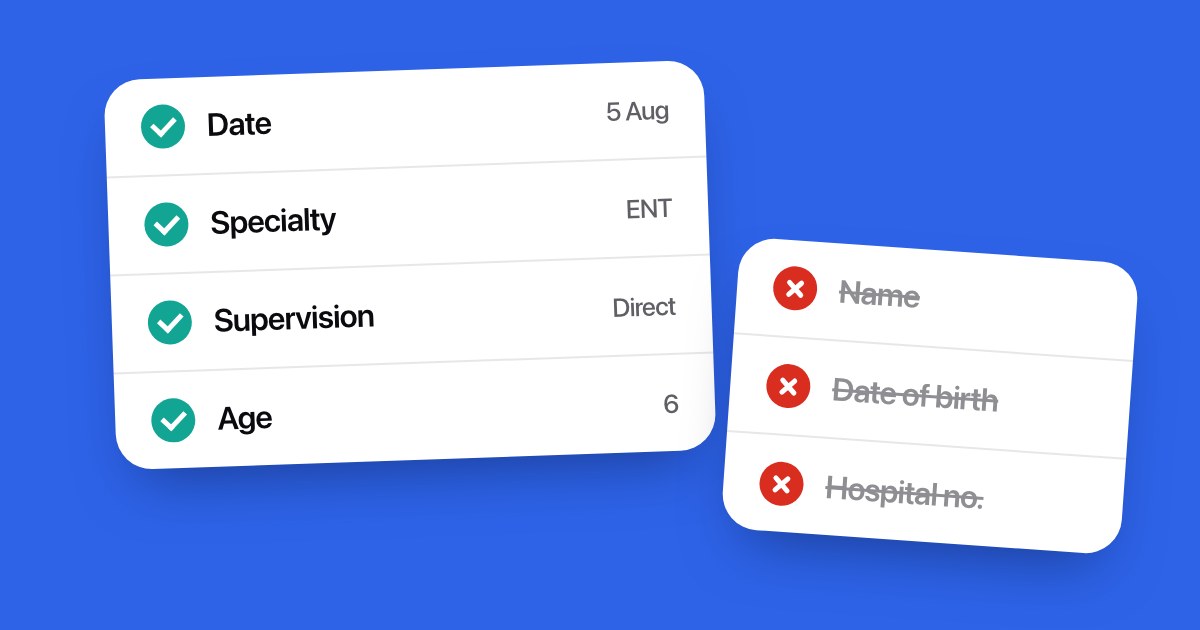
A logbook is a record of your own work. It needs enough to show what you did, how often and under what supervision, and nothing that points to a patient.
5 minute read · Reviewed 28 November 2026
Why keep one
If you are in training, a logbook is usually expected. In the United Kingdom, the Royal College of Anaesthetists expects doctors in training to keep an anonymised log of every case they are involved in [1].
In the United States, the ACGME publishes case log minimums and instructions for anesthesiology training programs [2], and your program tells you where and how to log. Other countries have their own bodies and their own rules.
After training, a logbook is still the simplest way to answer questions about your own practice: how many of a procedure you have done, when you last did one, and what your case mix looks like.
The fields most logbooks share
These are the fields in Induct and in the free logbook template. Induct needs the first four to save a case; the rest are optional.
| Field | What to write |
|---|---|
| Date | The day of the case. A start and finish time are optional, and let a report separate daytime from out-of-hours work. |
| Hospital | The name you use for the site. |
| Specialty | The surgical specialty, such as orthopaedics or ENT. |
| Supervision | How you were supervised, in the terms your training body uses. |
| Operation | The procedure the patient had. |
| Age and sex | The age, never the date of birth. |
| ASA physical status | The class assigned to the patient, 1 to 6, with E for an emergency. The scale and its definitions belong to the American Society of Anesthesiologists. |
| Priority | How urgent the operation was. In the UK this is usually one of the four NCEPOD categories, quoted below. |
| Type of anaesthetic | One per case, plus any additional techniques. |
| Regional blocks | Neuraxial and peripheral blocks you performed. |
| Procedures | Lines and other procedures, such as an arterial line. |
| Significant event | A few words on anything that went wrong or nearly did, with no patient details. |
| Notes | Anything else worth keeping, with no patient details. |
The four NCEPOD categories
The UK's National Confidential Enquiry into Patient Outcome and Death defines four categories of urgency. In summary, with the full wording at the source [3]:
- Immediate. To save life, a limb or an organ, with resuscitation going on at the same time. Normally within minutes of the decision to operate.
- Urgent. For a condition of sudden onset or worsening that may threaten life or an organ, for fixing many fractures, and to relieve pain or other distressing symptoms. Normally within hours.
- Expedited. Early treatment is needed, but nothing is an immediate threat to life, a limb or an organ. Normally within days.
- Elective. Planned or booked ahead of a routine admission, at a time that suits the patient, the hospital and the staff.
NCEPOD adds that the category describes the patient's urgency and not the kind of list the case was done on. Record the category the case was given, not the session it happened in.
What to leave out
Older guidance from the Royal College of Anaesthetists, still published on its site, is specific about this:
Patients must not be individually identifiable from the patient ID used.Royal College of Anaesthetists, Training documentation, section 8.2.1 [4]
The same section recommends recording only the age (not the date of birth), the sex and the ASA grade of a patient, and keeping no other unique numbers [4]. In practice that means none of these belong in a logbook:
- a name or initials;
- a date of birth;
- a hospital, medical record or national health number, or any part of one;
- an address or postcode;
- a photo that shows a face, a wristband or a labelled document.
Notes need the same care as fields. A rare condition, an exact date and a named hospital can identify someone with no name written anywhere. Keeping patient details out of a logbook goes through this in detail.
Habits that keep it accurate
- Log each case the same day. Details you reconstruct a week later are the ones that turn out wrong.
- Use the same name for the same hospital, operation and technique every time, so that reports count them together.
- Check your entries and your reports before you rely on them or hand them in.
Sources
- Royal College of Anaesthetists. Logbook for LLP users.
- Accreditation Council for Graduate Medical Education. Anesthesiology: documents and resources.
- National Confidential Enquiry into Patient Outcome and Death. The NCEPOD Classification of Intervention.
- Royal College of Anaesthetists. 8. Training documentation. An older document: it cites the Data Protection Act 1998.
All read on 28 November 2026.